
Alternative Water Source Study Presents Five Different Options
By Doug La Rocque
First, as Hoosick Falls Mayor Rob Allen highlights in a 10 minute video on the report, this report does not express a preference by the New York State Departments of Health (DOH) or Environmental Conservation (DEC) on which option is best. It simply lays out the facts about five options for the Village, the Town of Hoosick and the residents to consider, for possible replacement water sources for the current PFOA-contaminated wells.
Released to the public last Thursday, October 17, the report calls for a public comment period lasting until November 18, after which the report will be modified as needed. That final report, along with the feedback from the community, will, according to the Mayor, be a driving force in the final decision. Mayor Allen says in the video, “this is going to set the trajectory for our Village for the next century.”
The five options laid out in the report are:
• Development of a New Groundwater Source:
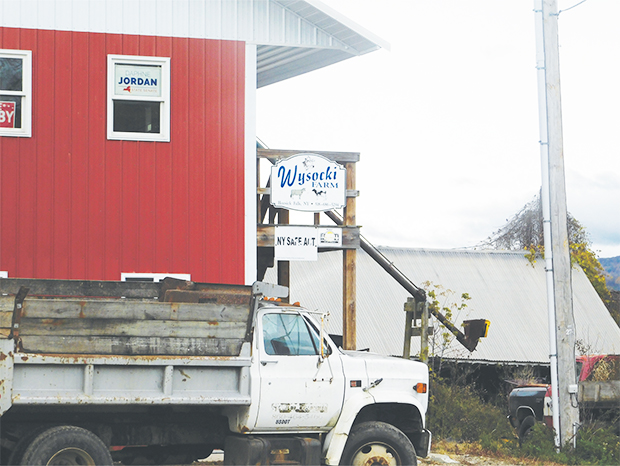
For this alternative, the LaCroix and Wysocki test wells located south of the Village would be converted to permanent production wells. The LaCroix well would be considered the primary source, with the Wysocki and Village Well # 7 as backup sources. The LaCroix test well produced a yield of 450 gallons per minute (gpm) and the Wysocki test well yielded 300 gpm for a combined capacity of 750 gpm or 1.08 million gallons daily (MGD). However, higher levels of production are considered achievable (especially in the LaCroix well) to attain the conceptual future maximum day demand of 1.13 MGD. The estimated cost for this alternative is $6.927 million.
• Development of a New Surface Water Source:
The Tomhannock Reservoir is the closest surface water source to the Village with adequate quantity and quality. Therefore, Alternative 2 explores the use of the Tomhannock Reservoir.
To consider the Tomhannock Reservoir as a new surface water source for the Village, several key pieces of new infrastructure would be required, including a raw-water intake, a raw-water pump station and pre-disinfection station, and a raw-water transmission main connecting the pump station to the Village Water Treatment Plant. Depending on the chemistry of the raw water, the addition of orthophosphates at the proposed pump station may also be required to prevent corrosion inside the transmission mains. The estimated cost of this alternative is $34.417 million
• Connection with an Existing Water Supply Source:
The City of Troy water system presents the closest public water supply source with sufficient quantity and quality to support the Village as a wholesale customer. Alternative 3 describes an interconnection with the City of Troy water system to provide an alternative water source for the Village. The water source for the City of Troy is the Tomhannock Reservoir, which is the surface water source proposed under Alternative 2. Alternative 3 would also use the Tomhannock Reservoir water source through a purchase agreement of treated water by the City of Troy water treatment facility. The estimated cost here is $48.552 million
• Continued Use of Public Supply Wells #3 and #7 with Treatment through Full Capacity GAC System:
This alternative (considered the do nothing approach) involves using the full-capacity GAC treatment system already in operation at the existing Village water treatment facility for the removal of PFOA. The system outlined in this alternative was approved by the NYSDOH, constructed, and became operational in February 2017. The full capacity GAC treatment system was designed to match the production rate of the existing water treatment plant (1.0 MGD) and was installed downstream of the existing microfiltration units. The GAC water discharge is subsequently treated with sodium hypochlorite to disinfect prior to distribution. The estimate cost of Alternative # 4 is $ 6.330 million
• Continued Use of Public Supply Wells #3 and #7 with Treatment through Full Capacity GAC System and PFOA Remediation through the McCaffrey Street IRM:
This alternative involves all the components of Alternative 4, plus measures to control offsite migration of groundwater toward the Village well field and reduce the volume of PFAS in the subsurface. Specifically, this alternative combines Alternative 4 with the McCaffrey Street IRM. The McCaffrey Street IRM was approved by NYSDEC on April 4, 2019, and is constructed and operating. The estimated cost is $10.090 million.
Rensselaer County Executive Steve McLaughlin released a statement that says in part, “now that water resources have been identified, the state needs to follow up with an effective and energetic response to help Hoosick Falls recover.” The executive further stated that “from the start, I have said the Tomhannock Reservoir may be a suitable answer to the issue. The Tomhannock has great resources and extension of water lines from the reservoir would generate revenues for Troy, expand economic development opportunities, and ensure clean water to not only Hoosick Falls but the entire area.”
Rensselaer County Legislator Bruce Patire has concerns about choosing the Tomhannock, and likes the new groundwater source option, at least at this point. He tells The Eastwick Press “we have the best filtration system in the world, and I want to see, in writing, an agreement with the responsible companies, to maintain it.” He also said he is concerned about entering into contractual agreement with another municipality. “I think it’s best when the Village has control of its own water and systems.”
The alternative water study is available on the DEC website, or broken down in segments on the Hoosick Falls Village website. Comments may be made by email to: HoosickWaterSupply@dec.ny.gov or by mail to: DEC Project Engineer, Ian Beilby, P.E. , Chief, Section C, Remedial Bureau D, 625 Broadway, Albany, New York 12233.