
Landfill Cleanup Scenarios Presented
by Alex Brooks
At the informational meeting held on Sunday March 8 at the Petersburgh Baptist church, an engineer and geologist from Sterling Environmental told the assembled citizens details about what is known so far about the Petersburgh/Berlin landfill and what will need to be done to contain the leachate that is seeping out of it. The presentation was given primarily by Mark P. Millspaugh, P.E., the President of Sterling Environmental, and Petersburgh’s environmental attorney Kevin Young.
Millspaugh said Sterling Environmental started work on the Petersburgh project in November 2019.
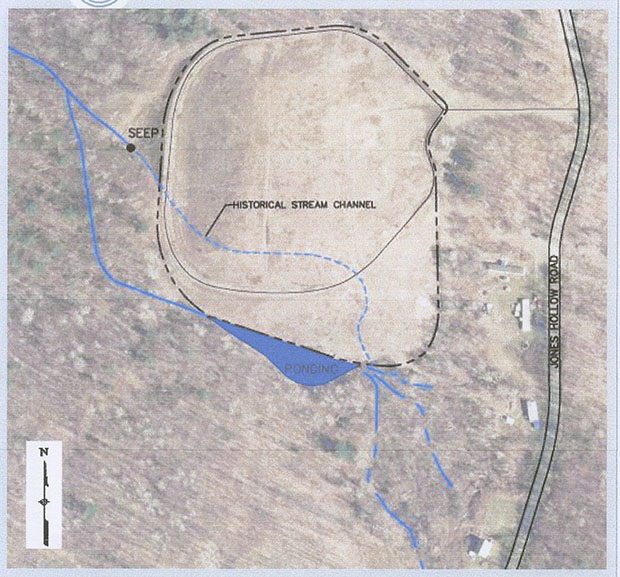
He said the place where the seep is coming out of the landfill at the bottom end is where there used to be a stream before the landfill was there. The perimeter drainage system was supposed to divert the water around the landfill to keep it from flowing through the garbage and becoming contaminated, but the perimeter drainage system is not working properly. He said the area where the stream flows towards the landfill at the upper end has been ponding because the flow is impeded in the ditch which is supposed to carry the water around the perimeter of the landfill. As a result the ground there is saturated and at least some of the water coming into that area from the stream is finding its way into the landfill and running down the historical stream channel.
Millspaugh said the first thing that needs to be done is to clear the ditch that is supposed to carry the water around the landfill in order to minimize the quantity of water going into the landfill. He said one of the critical issues is determining the quantity of contaminated water coming out of the leachate seep, because that will be a major factor in designing the leachate collection system. Toward that end, one of the earliest actions to be taken is to install what he called a “pipe weir” which would send all of the leachate seep coming out of the lower end of the landfill and run it through a pipe which has a flow measurement device in it. In this way the engineers can determine what quantity of liquid they are dealing with, and “determine site response to rainwater and seasonal variations in flow.”
Millspaugh then discussed various remedies that his firm might consider when they are designing the leachate collection system. He said one of the first measures they will consider is an effort to divert water arriving at the upper edge of the landfill so that it is routed around and away from the landfill and never finds its way into the landfill where it would be contaminated and come out the other side as leachate. Another method he mentioned is putting wells upstream to extract water before it is contaminated and pump it away from the landfill, but he said this would probably not be cost-effective.
Concerning actual collection and treatment of the leachate coming out of the landfill, he mentioned three alternatives. One is to collect it and pump it into a tank near the road, to be trucked to a treatment facility. He said trucking is “typically expensive and inefficient.” Another option is to build a little treatment plant onsite near where the leachate comes out, and release the water into the nearby stream after it has been cleaned. This requires pumps and electricity and daily monitoring by a skilled treatment plant operator, so the ongoing operations and maintenance (O&M) costs are significant. The third option, which he said is becoming popular in recent times, is to provide treatment through a gravity system. This is a wall installed in the ground which he called a “permeable reactive barrier.” This barrier acts as a filter with granular activated carbon (GAC) in it, and water flows through it by gravity. Contaminants are removed as the water flows through the barrier. The beauty of this system is that it does not require pumps or electricity, and it requires less maintenance. These barriers do need to be replaced periodically, though, as they become saturated with the contaminants they are collecting and become ineffective, in the same way that the GAC filters at the Water District’s treatment plant need to be replaced. He said such barriers are sometimes built with two walls, so that while one is being replaced, the other is still cleaning the water.
Members of the audience of course pressed Millspaugh for cost estimates for all of these options, but he said it is really too early to even guess at the final cost of these measures, as it will depend on the quality and quantity of the leachate, how long the permeable barrier needs to be, and a number of other factors that have not yet been determined. He said the study that his firm will be doing has as its goal an analysis of the site which will lead to a strategy for leachate containment, which will then proceed to more detailed designs and good cost estimates.
Kevin Young then talked about the timetable for activities under the consent agreement. He said the Town has six months to submit its first report about site characterization, but overall he expects it to take about two years to complete the study that would specify exactly what the Town will do to contain the leachate and what it will cost. Once that study is complete and DEC accepts it, then the Town can get a commitment from the State for the 90% grant funding. All of the funds expended for those first two years are eligible for 90% State funding, but the Town must front the money until it gets a State commitment two years into the process. Young said he is confident that the funds to be received from Taconic and Covanta will be more than enough to carry the towns through until they get a grant commitment.
Young reminded the audience that the 90% funding does not cover operations and maintenance costs, so once they have a realistic figure for O&M costs, they will need to assess where that money will be coming from. Young said at that point the towns will have the $500,000 received from Taconic and Covanta minus 10% of whatever it cost to complete the study and build the water diversion and leachate containment facilities.
He said if the O&M costs are extremely high, the towns do have the option at that point to abandon the consent order and turn the problem over to the State, but he doesn’t expect that to happen. He said, “I believe DEC will work with us to find an affordable solution, because they don’t want the problem dumped in their lap.” He noted that DEC is testing 1200 landfills across the State for PFOA in leachate seep, and if they ended up being in charge of cleanups at 1200 landfills, it would become a monumental problem for them. Since Petersburgh/Berlin is one of the first to go through this process, Young thinks that DEC will try to demonstrate that cleaning up a problem of this kind can be a manageable task for the many towns across the state who may end up with a similar problem of contaminated leachate seep.
But he noted that if other towns are to follow this model and use the landfill closure fund to contain leachate seeps, a lot more money must be allocated to that fund. He said money comes to that fund from the State Environmental Protection Fund. That fund gets about $300 million every year from the mortgage recording tax, but in recent years only about $250,000 per year has been allocated to the landfill closure fund, while many tens of millions have been allocated to land acquisition in the Adirondacks. The proposed allocation for this year is $756,000. He said the towns or activist citizens in the Towns should bring this matter up with elected officials and try to get more funding allocated into the landfill closure fund so that the backlog of applicants can get their projects funded. He said he thought the State should buy a little less land in the North Country and use the money saved to help little towns deal with their landfill issues. Petersburgh/Berlin is currently 11th on the list of applicants for money from this program, so ten other landfill closures must be funded before money will be available for the Berlin/Petersburgh project. But if State decision-makers allocated more money to the fund, the backlog could be cleared without lengthy delays.