
Hoosick Falls – Vevia M. Woodard, 77, died Wednesday, October 8, 2008, at the Centers for Living and Rehabilitation in Bennington, VT, after a long and courageous battle against cancer. Vevia was married to her loving husband Calvin Bryson Sr. for forty-seven years. [Read more…] about Vevia M. Woodard
Front Page
Linda K. Barnett
Hoosick Falls – Linda K. Barnett, 46, died Thursday, October 2, 2008, in Tucson, Arizona. She was the wife of Shawn Barnett of Tucson. [Read more…] about Linda K. Barnett
It’s A Wrap!


The filming of Taking Woodstock has wrapped up after shooting in the Stephentown Hotel last weekend. The hotel was made to look like the El Monaco, which was owned by Tiber’s parents. At the beginning of October filming took place in the Evangelical Community Church. Here, in a relaxed moment, the crew sits in and around the large tent set up near the Stephentown Hotel. (David Flint photo)
Public Tours Phase Two Of HFCS $8.3 Million Capital Improvement Project

Taxpayers Curious
by Bea Peterson
On Monday evening, October 6, several people took an opportunity to tour Hoosick Falls

Central School to see the improvements made inside and outside the building this past summer. Some of the older folks wanted to see where their tax dollars had been spent. This was the final scheduled open house. Parents had an opportunity to visit the school during the open houses held for the elementary classes and the high school.
Honor Society members were guides Monday. Superintendent Ken Facin, Principals Dailey and Leunig and other administrative staff were on hand to meet people and to answer questions. PTA members provided a large array of refreshments. Students, staff and PTA members were visibly proud of the progress made on the structure.
The guides showed off the auditorium which has a new sound system, new lighting, new curtains and refurbished chairs. “While the chairs were out the school maintenance staff cleaned up the floor and refinished it with a granular paint,” said Facin. “They did a great job.” Guide Megan McEachron said that last year the Drama Club didn’t use one set of curtains because they were afraid they would fall down. Events in the auditorium should be much more pleasant in the warm weather as it is now air conditioned.
The floors in both the elementary and high school gymnasiums have been sanded and refinished. They look beautiful. The Homecoming dance will be held in the high school gym this Saturday evening.
The high school cafeteria has been repainted and students are delighted with the addition of booths and round tables as well as new long tables.
All the mismatched lockers have been replaced. Now the halls are lined with only blue lockers. Half of the building has new windows and blinds. The guides said they are pleased with them because the lower portion has screens and open. The windows are tinted to cut down on sun coming in. The students have already found their classrooms to be much more pleasant. “They are definitely cooler in the warm weather,” said guide Erin Shea. The rooms have already proved to be warmer in the cool weather as a result of the new windows.
The school has a new fitness room equipped with strength, conditioning and cardiac equipment such as treadmills and stationary bikes. There is an impressive weight room as well. The guides said the rooms are open during the day and for two hours after school. “Students, staff and teachers are lined up to use them at the end of the day,” said Megan. The fitness room is especially helpful for special education students who have difficulty participating in regular gym classes.
A new technology classroom has replaced the former weight room.
Superintendent Facin said that the drainage projects and the new parking lot and sidewalks were the major improvements outside. Other improvements include a new security system and a phone and computer system that is the same throughout the building.
The new snack shack next to the athletic fields has already proved to be a big hit. On the other side of the school, work is underway on the new elementary playground. Once all the equipment is in place a level, soft surface will be poured. The playground will be handicapped accessible.

Voters approved the $8.3 million three-phase capital improvement project in 2006. Phase one, completed last year, included replacing the school’s roof and other outside projects. This year it was the many projects described above, and next year the rest of the windows will be replaced. Facin said the projects have been completed within budget. “We have to do a fiscal review of where we are now and look at what we are saving,” he said. “This is important in these economic times.”
Local Judges Not Impressed With State Report On Town Courts
by David Flint
Town Justices in the Eastwick area did not appear to be much impressed by a report issued last month on the Future of Town and Village Courts.
The report was the result of a study conducted last year by the Special Commission on the Future of New York State Courts. Chief Judge Judith S. Kaye of the NYS Court of Appeals established the Commission in 2006 to study and propose reforms to the State court system. This, their second report, focuses on town and village courts.
The Commission decided to take a pragmatic and “politically realistic” approach to reforming the local courts, avoiding draconian changes that have been unsuccessfully recommended in the past that would have done away with non-attorney judges and required a complete dismantling of the local justice system and amendments to the State Constitution. They also rejected the concept of District Courts – a uniform, State funded and State-run system of non-local courts – which they noted had failed to gain any widespread community or political support over the years.
They listed their findings and recommendations in four areas: the organization of the Justice Courts, qualifications of the Justices, facilities and resources and the role of fines and funding in the courts.
The Commission argues that not only is the “current jumble” of over 1,250 local courts not sustainable economically, it also affects the quality of justice that is delivered. “The funds that are wasted on duplicative courts diminish the amounts available to make critical improvements to court facilities,” they said. Then, too, they pointed out, with so many courts to service, prosecutors and public defenders are often unable to be present, resulting in delays of weeks and months. Their recommendation is that a panel working under State guidelines be established in each county that would have the authority to review each court in the county and decide which courts should be combined. The panels would address only the combining of courts and would not be permitted to recommend changes to the number of judgeships.
Regarding qualifications, the Commission noted that recent newspaper articles have pointed out that hairstylists and massage therapists require more training and certification than do town or village justices. They also point to a 1976 US Supreme Court ruling to the effect that just as criminal defendants have a constitutional right to be represented by an attorney, they also have a due process right to appear before an attorney judge. They concluded, however, that it is not feasible to require that all local Justices be attorneys. Their compromise recommendation is that incoming judges be at least 25 years old and have acquired at least a two-year college degree and that defendants in misdemeanor cases be given the right to “opt out” of the local court and have their case reassigned to an attorney judge. They would also expand the pool of qualified candidates by amending residency requirements so that a local judge could reside anywhere in the county or even in a neighboring county.
The Commission acknowledged that improvements in training and testing of judges had been made by an Action Plan instituted in 2006 by the Office of Court Administration (OCA). They recommended, however, that training and testing be further expanded and improved.
Currently local courts are funded by their town or village with some grant assistance from OCA’s Justice Court Assistance Program (JCAP). The Commission would expand and improve the JCAP and augment it with a direct State aid program earmarked for the courts to support their capital and security needs.
Currently most of the fines for traffic violations such as speeding or DWI go to the State or county. The local jurisdiction can retain 100% of fines for parking violations, resulting in quite a bit of plea-bargained “parking on the pavement” violations. The Commission made no specific recommendations regarding reallocating fines, but they suggested that the State Legislature revise the current procedures and establish a uniform sharing ratio so that both State and localities get an equitable share of all fines.
The Town Justices in this area who were asked their opinion had not yet had time to digest all the findings and recommendations in the Commission’s almost 300 page report, so none wanted to make any definite conclusions. Each, however, had some tentative remarks to make.
Wes Edwards, who has been Town Justice in Stephentown for 45 years, said that in his estimation he and Judge Cyril Grant and Court Clerk Debbie Coppola have been doing an adequate and professional job. Their first priority is safety, and the second is training. “We are proud of our court,” he said, “and we take it pretty darn seriously.” Edwards did not think combining local courts in this area would work well, and he thought it might just be the first step toward establishing District Courts. Who would have jurisdiction over the court, he wondered. In any case, he hopes he does not see it come to pass, and he also did not like the idea of expanding the pool for local judge candidates to anywhere in the county or beyond. He feels it is better to have a judge who knows the locality and its people. He thought the “Opt Out” provision might be ill-advised as it sounds like shopping for judges.
Edwards thought the age and educational requirements for local judges should be left up to the voters. Regarding training, however, he applauded the additional requirements resulting from the OCA Action Plan and was very much in favor of increasing the requirements further if deemed necessary.
Joe Rechen in Berlin sees the Commission’s recommendations as suggestions; they can’t be instituted arbitrarily and would need legislative approval. Some of the recommendations, such as the combining of courts will require a lot of planning on specifics such as sharing of revenues. He said it would be premature to comment on the substance of the recommendations at this time, but he did note that the Commission had ruled out District Courts. “Nobody is in favor of District Courts,” he said, adding that they have not had a good track record in Massachusetts, where he believes they are not smoothly run and do not provide speedy redress.
Siegfried Krahforst, who has been Town Justice in Petersburgh for 28 years, felt the Commission was placing a lot of weight on a judge having a law degree, but Krahforst said he thinks that just the opposite is often better. His experience has been that judges with law degrees often try to follow the law to the last letter and sometimes don’t use common sense. They follow the book even with small complaints, not allowing a chance to resolve the situation without it becoming a big problem.
Regarding the “Opt-Out” recommendation, Krahforst said even now judges have a lot of leeway. All felony cases go to County court, but if charges are reduced they can come back to Town court. Some cases can be transferred to Family Court and others to drug courts or alcohol abuse courts.
Krahforst noted that the State pays nothing now to run the town courts. He wondered if courts are combined, who would pay for it. He suspected the combined courts would need full time judges which means more money from taxpayers.
Dennis McGurn, for 15 years Town Justice in Grafton and a Director on the Board of the NYS Magistrates Association, said the Magistrates have a committee working on consolidation of some courts. The Rensselaer County Magistrates, however, are opposed to combining courts because all the courts in this county are very busy now. McGurn noted, too, that the Village Board of Hoosick Falls had recently considered eliminating the Village Court and using the services of the Town Court, but the people of Hoosick Falls had voted against it.
He tentatively disagrees with the “Opt-Out” proposal because he believes the current system is working adequately. He said the New York City Bar Association was pushing for all judges to have a law degree, but the NYS Magistrates Association was opposed to any such requirement, even though 25% of the members have law degrees. McGurn feels that under the OCA Action Plan the local judges are required to get plenty of training. “The local judges are doing a very good job, even the non-attorneys,” he said, “and the small courts are being run correctly. These judges have been around for years, and they know what to do.” He added that justices are constantly attending training sessions and noted that he had a hand in setting up some of that training when he was President of the Rensselaer County Magistrates Association.
Thomas Restino, Jr. has been a judge for 13 years and now serves as Justice in both the Town of Hoosick and the Village of Hoosick Falls. He would agree with the Commission that the local courts can use some streamlining and more efficiency but is not so sure about consolidation and “opting out.” He noted that the courts in Hoosick and Hoosick Falls are already very busy and pointed out that, “These courts were set up to be the closest courts to the people.” As for opting out, he argued that not being a lawyer does not mean a justice cannot properly handle a case. The local judges, he said, now get a lot of training.
Restino thought it was probably a good idea to require incoming judges to be at least 25 years old and have a two-year degree, though he did point out that there are currently a lot of people with only a high school education who have been very successful as judges.
Stephentown Justice Wes Edwards Recognized For 45 Years of Service
by David Flint

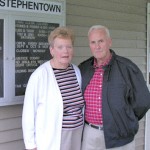
Stephentown Town Justice Wes Edwards has received Special Recognition from the New York State Magistrates Association for his 45 years of continuous service in the local justice system. The Association, at their Annual Conference on September 22 in Niagara Falls, awarded Edwards with an engraved medal with his name, Hon. Wesley R. Edwards, and the Town of Stephentown engraved upon it.
Edwards is the longest serving judge in Rensselaer County. He has also been an active member of the Stephentown Volunteer Fire Department for over 40 years and is a long time member of the Empire State Masonic Order Unity Lodge #9 in New Lebanon. He was employed by General Electric for 25 years until retiring in 1992.
Mildred R. Whitman
Hancock – Mildred R. “Millie” Rathbun Whitman, 94, of Main Street, Hancock, MA, died on Friday, October 3, 2008, at Springside of Pittsfield under the care of HospiceCare in the Berkshires.
Born in Hancock on September 10, 1914, she was the daughter of Chloe Rathbun and was raised by her grandparents Alfred and Blanche Rathbun. She was the loving wife of the late William H. Whitman who died on August 29, 1987. They were married in Pittsfield, MA, on June 17, 1933.
A lifelong resident, she attended schools in Hancock and Pittsfield. She served as postmaster of the Hancock Post Office in her home for over 35 years retiring in 1996. She was a member of the Hancock Grange for 76 years and a member of the Hancock Baptist Church. Millie was also involved in the Red Cross, the Willing Workers Community Group and was a 4H leader. She loved animals and flowers.
Survivors include her daughter, Alma Whitman and husband Richard Kingsley of Manchester, CT, a foster daughter, Georgianna Balantine of Alabama, her grandchildren, Duane A. and wife Elaine Kingsley of Coventry, CT, Dean and wife Donna Kingsley of Hancock, and a great-granddaughter, Hannah Mildred Kingsley. She is pre-deceased by a son, Henry A. Whitman, and a foster daughter, Gladys Lee Cullman.
Funeral services were held on Tuesday evening, October 7, at 7 pm in the Hall & Higgins Funeral Home, 457 NY 43, Stephentown where Rev. Angela Buchauer officiated. Relatives and friends were invited for visitation starting at 4 pm on Tuesday. Private interment will take place in the Hancock Cemetery next to her loving husband.
Memorial contributions may be made to the Hancock Baptist Church, the Community Christmas Tree at Hancock School, the Hancock Volunteer Fire Department or the American Cancer Society Relay for Life in care of the funeral home, PO Box 9, Stephentown, NY, 12168, in loving memory of Millie.
Rufus E. Hall
Hoosick – Rufus E. Hall, 83, of Petersburgh Junction Road, Hoosick, NY, passed away Thursday, October 2, 2008, at the Centers for Living & Rehabilitation in Bennington, VT. He had resided in Hoosick with his wife Janet (Bain) Hall.
Born in Shaftsbury, VT, on June 1, 1925, Rufus was the son of the late William and Gertrude (Bump) Hall. He was employed at Stanley Tools in Shaftsbury for over twenty-five years. After retiring he had a small greenhouse business at his house for about twenty years. He enjoyed working outdoors, especially in his flower and vegetable gardens.
Survivors other than his wife Janet include his children, Janette Galusha and husband David, Robert Hall and wife Rosalie, all of Hoosick Falls, William Hall and wife Lorrie of Chantilly, VA. He is also survived by brothers, William “Stub” Hall and wife Ida of Cambridge, NY, and Richmond Hall and wife Mary of Shaftsbury, sisters, Donna Pradon of Maine, Marilyn Harrington, Helen Squires and husband William and Roberta Reynolds, all of Shaftsbury, grandchildren, Jennifer, Matthew, Dachia, Bryan, Deidra, Andrew, Eric and Zachary, great-grandchildren Rachel, Jeffrey and Branden. Rufus is pre-deceased by a sister, Fabiola Gills.
Relatives and friends called at the Mahar Funeral Home, 43 Main Street in Hoosick Falls on Sunday, October 5, from 2 to 4 pm. Funeral services and burial will be at the convenience of the family. Memorial contributions may be made to the Southwestern Vermont Cancer Center through the funeral home.
Schuyler A. Bink Jr.
Hoosick Falls – Schuyler A. Bink Jr., 78, of the Danforth Adult Home in Hoosick Falls, NY, formerly of Dyken Pond Road, Petersburgh, NY, died on Sunday, October 5, 2008, at the Southwestern Vermont Medical Center in Bennington, VT, after a long illness.
Born in Poestenkill, NY, he was the son of the late Schuyler Sr. and Alice Kaiser Bink and husband of the late Amanda Yerdon Bink. Schuyler was a lifelong resident of the area and was retired from Al-Tech Specialty Steel in Waterviliet, NY, where he was a cutter. Schuyler’s greatest passion in life was to spend his time fishing, hunting, trapping and camping.
Survivors include his children, Schuyler Bink III, William Bink, David Bink and Sharon Merrills, a brother, Robert Bink, his sisters, Doris Lewis, Patricia Miller and Linda Smith, eight grandchildren and four great-grandchildren.
Relatives and Friends were invited to call at the Perry-Komdat Funeral Chapel, 2691 NY 43 at Glass Lake, Averill Park, NY, on Wednesday from 4 to 6 pm. A graveside service was held on Thursday at 10 am at the Woodside Cemetery, 56 Road, East Poestenkill, NY.
High Speed Police Chase In Stephentown Ends In Crash

by David Flint
People who stopped at an accident last Friday afternoon in Stephentown Center were left wondering what was going on when two State Police cars came speeding down Route 43 but whizzed right by the accident and sped down Newton Road toward Black River Road. Turns out the State Troopers were involved in a pursuit, and the woman whose car spun out on Route 43 at the same time had nothing to do with it.
The Troopers were chasing Christopher Beckwith, 24, a former Stephentown resident, now residing on Miller Hill Road in Sand Lake.
According to Trooper Maureen Tuffey, Public Information Officer for Troop G, the Rensselaer County Sheriff’s Department had put out a radio broadcast about a reckless driver in a red pickup truck in the Stephentown area. A trooper caught up with him and attempted to pull him over, but he refused to stop. The chase continued up Route 43, over Newton Road to Black River Road. Beckwith struck the Trooper’s car before heading west onto a trail that runs below the nationalgrid power lines. The Trooper then proceeded back up Route 43 and around to Calvin Cole Road thinking to catch Beckwith when he came out of the trail onto that road. He was joined by another trooper at that point. It is not clear what happened then but it seems Beckwith must have turned back down the trail toward Black River Road and the troopers seeing this rushed back down Route 43 to Black River Road. It was at this point that they whizzed past the spin out in front of the Stephentown Center Community Church.
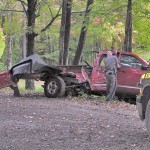
The troopers arrived at the entrance to the power line trail and attempted to stop Beckwith there, but Beckwith was not to be stopped. He came barreling out of the trail onto Black River Road coming close to running down one of the officers. He swerved left and headed down Black River Road. The astounded trooper then jumped in his patrol car and continued the chase. Less than a quarter of a mile down the road, however, Beckwith lost control of his truck and crashed into a tree and the chase was over. The troopers suffered minor injuries trying to extricate Beckwith from the crash, and Beckwith had some minor injuries but miraculously no one was seriously injured from Beckwith’s recklessness. Tammy Madden, who stopped to direct traffic at the spin out accident said she had a close call a little earlier when Beckwith, pursued by a trooper, came charging out of Staples Road onto Route 43 without slowing down and headed up the road directly in front of her.
Tuffey said the chase covered five miles at an average speed of 60 miles per hour. Beckwith was charged with DWI, assault and numerous vehicle and traffic violations. He was remanded to Rensselaer County Jail.
Beckwith was involved in another high speed pursuit in the Town of Berlin back in 1999. At that time he was driving an ATV and refused to stop for a Trooper. He ended up in a ditch across the road from the Berlin Community Cemetery with serious head, shoulder and spinal injuries. Beckwith said the trooper tapped him with his patrol car from behind causing his crash. Four years later, despite being charged with operating the ATV in a dangerous and reckless manner and failing to comply with a lawful order of a police officer, he won a judgment against the trooper in the New York State Court of Claims.